I teach drawing at Colby College, in a narrow, rectangular room on the second floor of the Bixler Art Center. Even when the floor is freshly waxed before the semester begins, the air still smells faintly of India ink and newsprint in lingering evidence of continuous use. During slideshows on perspective I share a few drawings by Harriett Matthews, one of my predecessors in this studio, where she taught drawing from 1967 through 2013. Many feature wide expanses of the Greek islands and countryside rendered in energetic cross-contour lines. Undulating rows of apricot and olive trees dot the page, their rounded forms echoing her sculpture. Stone buildings weave among the patchwork of orchards and fields in ever-diminishing scale into the distance, the drawn lines evaporating into the atmosphere of the page.
Through sustained observations over several decades of travel, Harriett’s drawings are evidence of an ongoing dialogue; a call-and-response with places as she saw them directly and as she understood them through the palpable sense of their histories. They are translations: form into contour, textures into pattern, differing tones defining the illusion of space. At moments her lines jump free of the boundaries they otherwise define, shooting off like illegible cursive or a wave of sound, evoking the living energy or feeling of a place beyond what the purely descriptive alone can capture. When she erases, soft-edged white marks carve through these different strata of depiction like an elemental force—wind, weather, or erosion—tempering the decisive silver of the graphite. It is an active form of seeing, never still, never numb to what is being perceived. When I point to these drawings, part of what I mean to communicate to students is that they are now part of this dialogue too.
I only knew Harriett briefly, having met during receptions at the Colby College Museum of Art. She spent a great deal of time with each work on display, and I overheard her bemoan the speed with which other visitors breezed through the gallery. Don’t they realize what they’re missing? The nuance of material, the qualities of line, the subtle humor of a particular image, all revealed to her careful attention and delight. “It’s incredible,” she said.
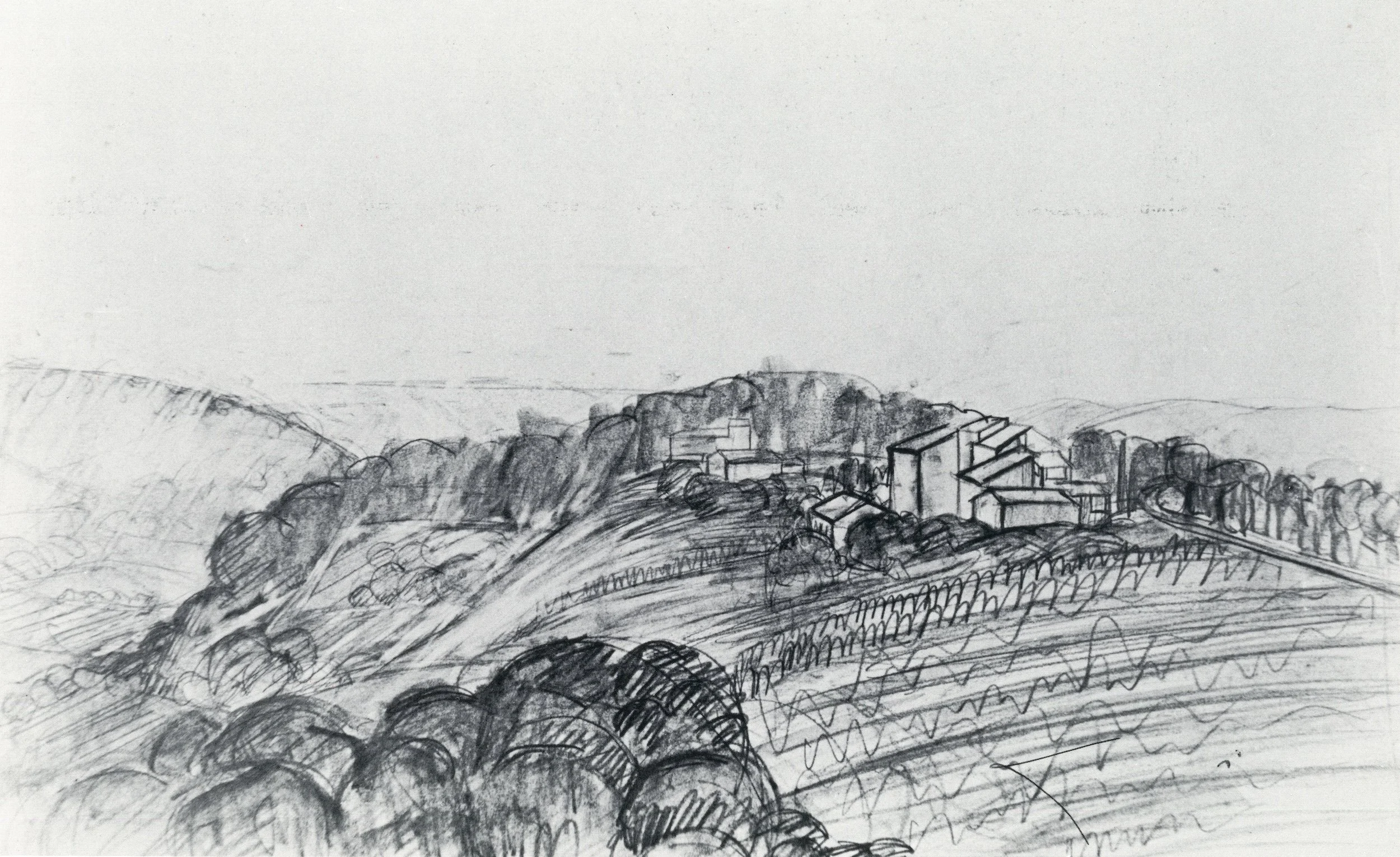
Harriett Matthews (1940-2026), San Casciano, graphite, 12 x 19 in., 1985; as reproduced on the invitation to “Harriett Matthews: Recent Drawings and Sculpture,” March-April 1988, courtesy Colby College Museum of Art